Lessons from the Iberian Peninsula Blackout: Why Satellite Connectivity is Critical
During Spain and Portugal’s massive power outage in the spring of 2025, nearly everything stopped working, including local cellular networks. As a result, voice and data communications were disrupted, causing an estimated $1.8 billion in economic losses and leaving enterprises, first responders, governments, and citizens disconnected from each other for over ten hours.
Emergency services were unable to rely on the usual terrestrial communications channels and had to improvise. Fortunately, many agencies that had prepared in advance were able to utilize satellite communications (satcom), which allowed them to make phone calls, send text messages, and access the Internet.
Their experience working to help citizens of the Iberian Peninsula during a time of crisis is one of the clearest examples of why reliable satcom systems are needed. Resilient satcom is an invaluable lifeline during cellular network disruptions, providing people with the ability to stay connected when maintaining contact is essential for health, safety, and continuity of organizations and society.
How Iridium satellites helped keep Spain and Portugal connected
The blackout hit Spain and Portugal in the middle of the workday around 12:30 p.m. local time, and as a result, operations throughout the area immediately shut down. Traffic lights shut off, and devices or equipment relying on cellular networks were rendered useless. This led to a curtailing of any available information, leading to a spread of misinformation about the cause of it and when the power grid could turn back on.
Despite the panic that ensued over several hours with no access to power, not all communications were lost. Many government and emergency services were able to coordinate and share information over Iridium® satellite network-connected devices.
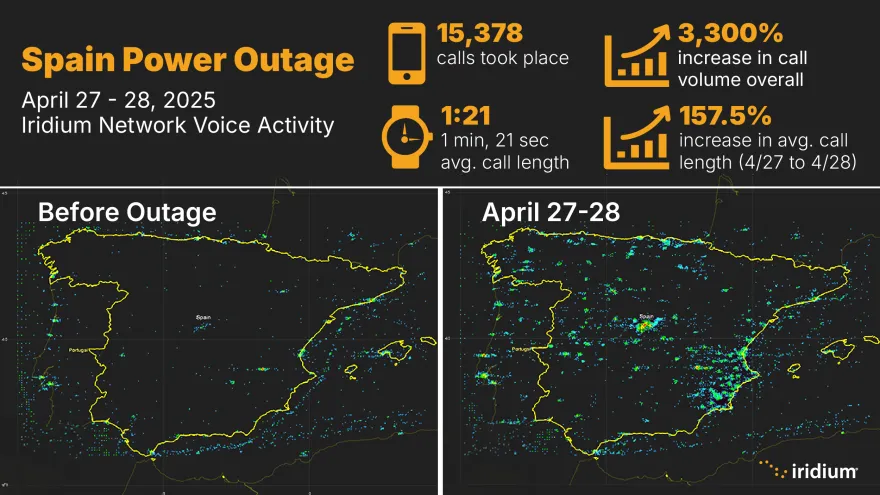
Indeed, the Iridium network voice activity experienced a massive spike during the blackout. In Spain alone, more than 15,000 calls were placed over the Iridium network, with each call averaging one minute and 21 seconds. Those numbers represented a 3,300% surge in satellite call volume and a 157% increase in average call duration.
The volume and length of the calls showed that many emergency services personnel, critical infrastructure workers, and business operators turned to Iridium ConnectedTM solutions for acute, focused communications to manage the crisis. Unlike traditional cellular systems, which are vulnerable to natural disasters, power outages, or grid failures, Iridium is resilient to these types of ground-based disruptions. In particular, Iridium’s low-Earth orbit (LEO) constellation not only blankets the entire planet in coverage but also provides service using weather-resilient L-band spectrum, making it more reliable than other systems.
The communication continuity lesson taught by the Spain and Portugal blackouts
The event that took place in the Iberian Peninsula is a lesson in not just resilience, but planning for the unexpected. Cellular networks cannot be the only lifeline when disaster strikes. Residents, first responders, city and state officials, and businesses need the reliable and pervasive communications safety net that satellites provide.
Before the blackout, there had been many other examples of communications being hampered by natural disasters. Hurricane Helene left millions across Florida and the southeastern United States without mobile coverage for days. In Europe, massive floods caused widespread power and telecom outages. In the Philippines, deadly typhoons knock out cellular coverage for entire provinces.
The threat of environmental disaster will always be present and is increasing meaning that there is a growing demand for communications technologies that can withstand violent weather and other ground based disasters.
Naturally, those technologies are not located on the ground. They’re orbiting several hundred miles above the planet, and they’re the difference between a community that remains connected and able to keep moving forward in the face of disaster. The important takeaway to note is that government agencies and critical industries need a business continuity plan that includes satellite communications to help ensure communication and coordination can continue during these unexpected events. Iridium and our ecosystem of global partners are well-positioned to help advise customers on how they can improve their communication resiliency.