
GPS and GNSS have some inherent vulnerabilities and are open to serious threats. Here are three examples:
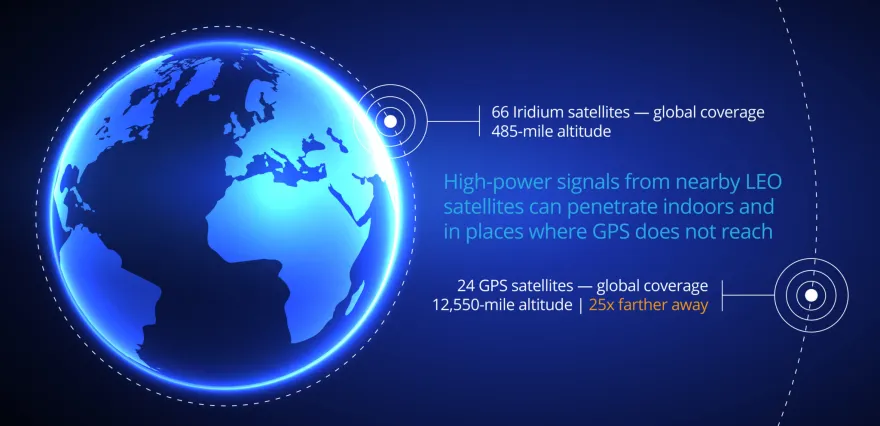
- Lack of signal strength. The GPS signal is essentially a “whisper” from satellites orbiting at an altitude of 12,500 miles, which means it’s not as strong or available everywhere.
- Susceptible to signal degradation. Buildings, tunnels, tree canopies, and other obstructions can obstruct GPS/GNSS signals. This creates a problem for PNT-dependent systems that are indoors or in other locations where GPS cannot easily reach.
- Risk of potential signal disruption. System outages, while rare, can have a profound impact on GPS/GNSS availability or accuracy. And bad actors can deliberately attack GPS to disrupt or deny its legitimate use or disrupt its signal to give a false impression of one’s location pose an increasing threat.
These factors are why Iridium PNT is a critical service for many industries. It goes where GPS and GNSS cannot—indoors and in other areas where GPS is unable to reach.
With a powerful signal emanating from Iridium’s constellation of low-Earth orbit satellites, Iridium PNT is the ideal complement to GPS/GNSS.