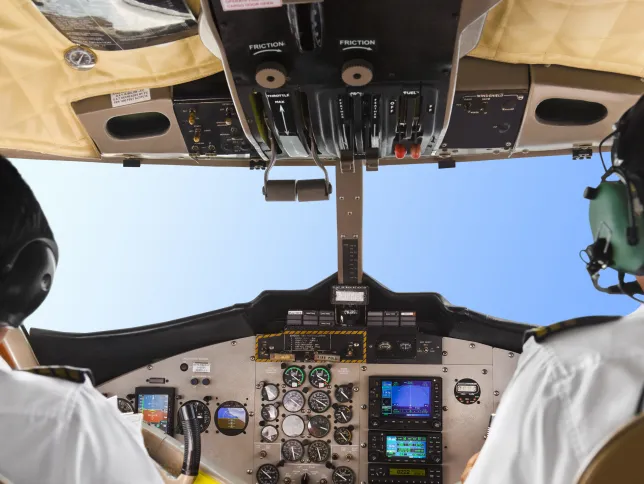
With commercial aircraft transporting people and goods around the world, reliable communications, especially satellite communications (SATCOM) is a must.
Our connectivity is used for safety operations on thousands of aircraft today, from business jets to Airbus and Boeing commercial airliners and global cargo operators enabling the safe transport of people and goods.
Commercial Aviation Overview
Big-name commercial airlines require robust connectivity for their fleet that enables critical communications for pilots and flight crew, and the reliable delivery of aircraft telematics and safety data.
We have been a leader in the industry for over 15 years and work alongside global regulators to help establish carriage requirements and standards.
These organizations include the International Civil Aviation Organization (ICAO), the Federal Aviation Administration (FAA), Airlines Electronic Engineering Committee (AEEC), Systems Architecture and Interfaces Subcommittee (SAI), and the International Telecommunication Union (ITU).
We are the only crosslinked satellite network that covers the entire planet with reliable, L-band satellite connectivity (including the polar regions). This makes communication possible in all global airspace, from any altitude and through adverse weather conditions.
Low-gain, lightweight antennas that are solid state and use either electronic steering or omnidirectional technology.
Small footprints that induce far less parasitic drag on the aircraft, helping cut down on fuel costs.
Industry-standard bolt pattern that simplifies installation.
Industry-leading manufacturers, offering end users choice and diversity of suppliers.
We Help Connect the Cockpit, the Crew and the Aircraft Itself
From helping pilots communicate with air traffic controllers on the ground to enabling accurate and truly global tracking capabilities, our aviation product and services are helping create a more connected global airspace.
Primarily data-driven and supports non-safety applications, such as aircraft operations and flight information.
Graphical weather data, flight plan updates and navigation chart and terrain database updates need to be quickly shared with ground operations.
Flight Crew Communications
In addition to the cockpit, we also connect the crew.
With these services, crew members can make voice calls, send messages and transmit critical in-flight group operations, such as passenger list management, in-flight credit card processing, inventory restocking, logistics management and equipment malfunction alerting.
Crew members are also able to make emergency calls for telemedicine purposes.
Aircraft Monitoring
While tracking aircraft is extremely important, there’s also a need to monitor onboard activity.
Our network connects aircraft technology that tracks the health of an aircraft through system monitoring and maintenance applications.
Operators can see which parts need maintenance and can intervene at the next destination. The ability to conduct proactive and preventative maintenance can greatly increase in-flight efficiencies and cut costs.
We Enable Critical Safety Services in Every Air Space
Aeronautical Mobile Satellite (Route) Service (AMS(R)S)
AMS(R)S is a globally regulated aviation safety service. It is comprised of voice and data services enabling communication between aircraft and Air Navigation Service Providers (ANSPs), also known as air traffic control.
The voice component is called Air Traffic Service Safety Voice (ATS Safety Voice) and the data component is known as the Future Air Navigation Systems (FANS).
Iridium ATS Safety Voice operates under requirements and guidelines set by ICAO and ensures safety-related voice calls are prioritized over all other voice and data communications.
FANS is only used for remote, oceanic and polar operations. It is comprised of two kinds of data messages – Automatic Dependent Surveillance-Contract (ADS-C) and Controller-Pilot Datalink Communication (CPDLC).
ADS-C messages contain position information and can be sent at predetermined intervals automatically or by request of the ANSP.
CPDLC messages contain operational information such as departure clearances, flight path changes, re-routes and weather information that makes air traffic management more efficient.
Looking ahead, we are working to introduce Aeronautical Telecommunication-Open Systems Interconnection (ATN/OSI) and Aeronautical Telecommunications-Internet Protocol Suite (ATN/IPS) services.
ATN/OSI, an inter-network architecture that allows ground/ground, air/ground, and avionic data subnetworks to interoperate by adopting common interface services and protocols, is based on Open Systems Interconnection and has been adopted to aviation applications.
The more efficient ATN/IPS is based on modern Internet Protocol (IP), and Iridium Certus® is targeted to support these services in the future.